
The first lesson they try to hammer into your head at Quantico is that every detail matters. Not because every detail is important, but because nobody knows which detail will become important until months later when an investigation suddenly breaks open. The instructors talk about observation and the way preachers talk about faith. They tell stories about cases that turned on a crumpled receipt stuffed into a jacket pocket, a reflection caught in a storefront window, a set of muddy footprints leading in the wrong direction, or a family photograph hanging in the background of a room that nobody bothered to examine twice. The job is not seeing what everyone else sees. The job is to see what everyone else overlooked. Most of the time those details appear meaningless. Then one day they become the thread that unravels the entire sweater.
The strange part is that while you're learning all of this, you may find yourself wondering whether you belong there at all. The hallways are filled with people who seem as though they were assembled from the same government-issued blueprint. They know exactly how to answer every question, exactly how to stand, exactly how to speak, and exactly when to nod in agreement.
Some of them look less like future investigators and more like highly motivated mall cops who somehow won a federal lottery ticket. You learn the procedures, memorize the protocols, survive the physical training, pass the exams, and keep moving forward, but there is always a small voice in the back of your head asking whether everyone else drank from the same pitcher of Kool aide and you somehow missed your turn.
By graduation, you assume your future will be spent chasing fingerprints, analyzing DNA, reviewing surveillance footage, cultivating informants, executing search warrants, and following money trails through shell companies and bank records. That's what the movies tell you federal agents look like. That's what the public thinks the FBI does. That's what most newbie agents expect when they report for duty. Then somebody slides a photograph across your desk and everything changes.
You glance down expecting to see a crime scene, a suspect, a vehicle, or perhaps a grainy surveillance image pulled from a gas station camera somewhere in the middle of nowhere. Instead, you're staring at a section of human skin. A tattoo.
You study the image for a few seconds, waiting for the rest of the evidence package to arrive. Nothing comes. The senior agent sitting across from you folds his arms and asks a simple question. “What do you see?” You answer the way any normal person would. “A tattoo, duh” He nods like a horse on the spectrum, then says, “What else?” You lean forward and take another look. Then state ok, uhmmm, a skull, some lettering, a few symbols.
The artwork isn't particularly impressive. You've seen better work hanging on the walls of tattoo shops. Nothing about it appears worthy of federal attention. The senior agent says nothing. He simply waits. That's when you realize you're not looking at artwork, you're looking at intelligence, then suddenly the urge you were having before the senior agent interrupted your alone time, to go to the vending machine on the third floor to get a Snickers bar goes away.
You focus and start processing……... that skull isn't just a skull, the shitty lettering and the placement means something. Every mark on that piece of skin communicates information to somebody who knows how to read it. Somewhere out there is a group of people who can look at that tattoo and immediately understand things that remain completely invisible to everyone else.
The tattoo isn't evidence attached to a case. The tattoo is the case. That realization sounds obvious today, but it wasn't always. Long before facial recognition software, social media profiles, and smartphones that tracked every movement, investigators were already paying attention to tattoos. Detectives noticed that gang members marked affiliations through symbols, prisoners developed visual languages understood only by those inside the system. Organized crime groups adopted imagery that identified rank, loyalty, geography, and history. Military personnel carried symbols of service, and outlaw motorcycle clubs built entire identities around patches and artwork. What appeared to be personal expressions on the surface often contained layers of information hidden underneath.
Somewhere along the way, somebody inside the Bureau asked a simple question: what if we started cataloging it? Not the artwork. The meaning.
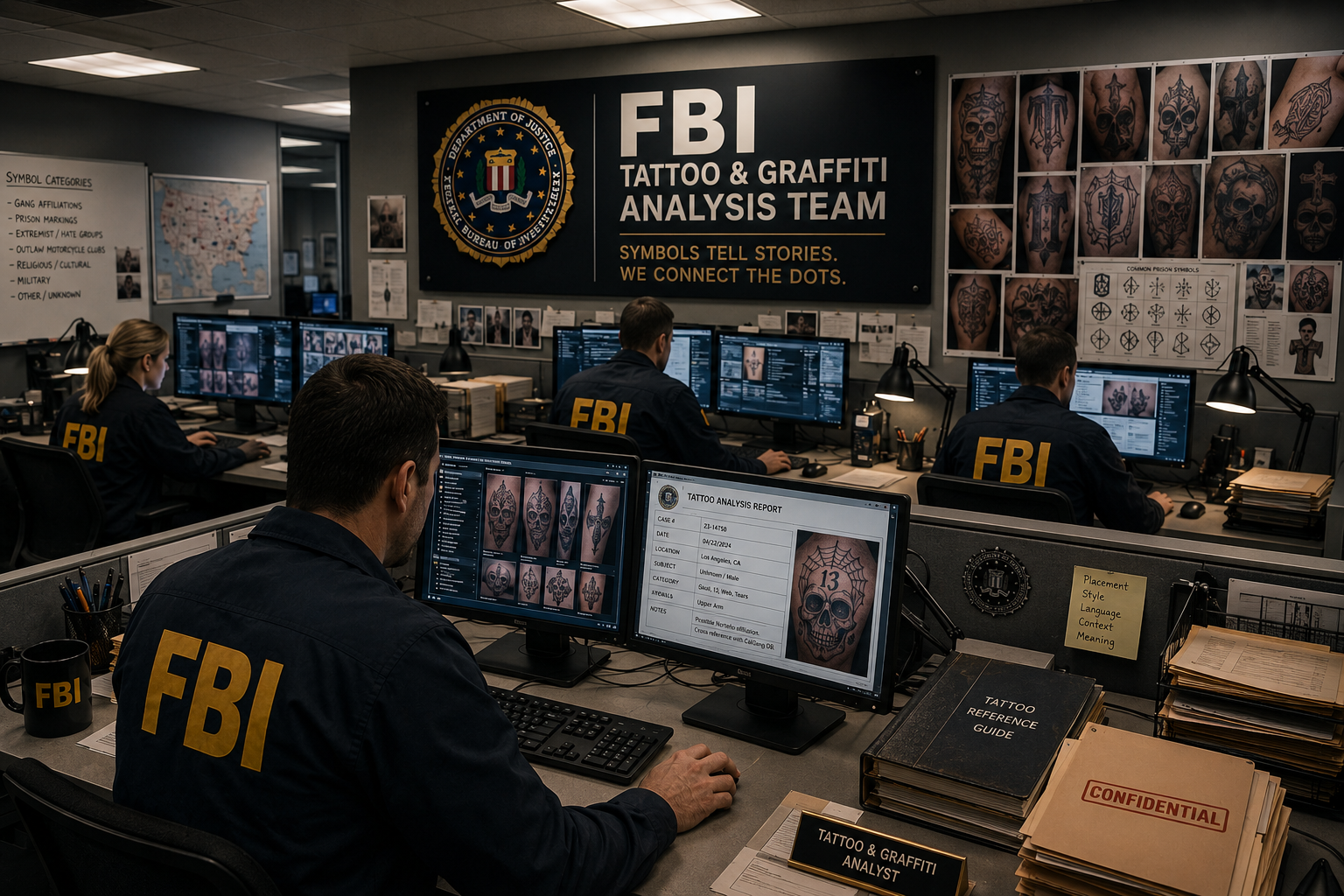
That question eventually evolved into specialized tattoo analysis capabilities inside the FBI, including what became publicly known as the Tattoo and Graffiti Analysis Team. Analysts began collecting tattoo photographs, documenting symbols, tracking recurring imagery, and identifying patterns that crossed city, county, and state lines. A tattoo found during an investigation in California might connect to an organization operating in Texas. A symbol documented inside a prison system might surface years later during an organized crime investigation hundreds of miles away. What once appeared to be isolated pieces of artwork suddenly became pieces of a much larger puzzle.
The strange thing is that tattoo artists understood this concept long before the Bureau did, they simply approached it from the opposite direction. Walk into any tattoo shop and ask an artist about the meaning behind a design and chances are you'll get a story. Maybe it's cultural heritage, or a reminder of a difficult chapter in someone's life, a symbol of survival. Artists know tattoos carry meaning because they spend their careers listening to the stories attached to them.
The Bureau simply arrived at the same conclusion through a different door. One side saw art while the other side saw information and both turned out to be right.
Eventually the FBI stopped treating tattoos as an interesting side note and started treating them as a legitimate intelligence resource. Analysts studied affiliations, prison markings, extremist iconography, gang identifiers, languages, symbols, and visual patterns that could help investigators connect people, organizations, locations, and criminal activity across jurisdictions. Somewhere inside the federal government, there are professionals whose job is to look at tattoos all day long, not because they're tattoo collectors or enthusiasts, but because the Bureau concluded that tattoos contain information valuable enough to support criminal investigations.
That realization should probably make every tattoo artist smile for a moment. The same thing that makes a great tattoo artist successful is often what makes a great intelligence analyst successful. Both professions require the ability to recognize patterns, understand symbolism, appreciate context, and see meaning where other people see random images. One person is creating the story. The other is trying to read it.
What's fascinating is that tattoo artists have been functioning as historians, archivists, psychologists, and storytellers without ever describing themselves that way. Every day they sit across from strangers and hear stories that never make the evening news. Stories about military deployments, addiction recovery, prison sentences, lost children, dead parents, cancer battles, marriages, divorces, faith, regret, redemption, and survival. Those stories are translated into images and carried through life on human skin.
The Bureau eventually recognized what tattoo artists already knew that people leave pieces of themselves in their tattoos. The difference is that tattoo artists were listening to the stories while investigators were learning how to read the clues. Perhaps that's the most fascinating part of this entire story.
What began as an investigation into how the FBI studies tattoos eventually became a reminder that tattoos are connected to far more than the tattoo industry itself. They intersect with law enforcement, military history, prison systems, psychology, cultural identity, organized crime, personal expression, and even intelligence gathering. A tattoo may be artwork to one person, evidence to another, and a historical record to a fourth. Few forms of human expression travel across so many different worlds at the same time.
That reality is one of the reasons Inker.com exists. The tattoo community is far larger and far more complex than most people realize, and some of the most interesting stories connected to tattooing have very little to do with tattooing itself. They live at the intersection of culture, history, business, law, human behavior, and occasionally places nobody would expect, including inside the investigative files of the Federal Bureau of Investigation.
While most tattoo publications focus on artists, conventions, and portfolios, Inker.com will continue exploring the stories that exist beyond the tattoo chair. The stories hiding in courtrooms, museums, military archives, patent filings, historical records, forgotten newspaper articles, and yes, sometimes even government intelligence reports. Because the deeper you dig into tattoo culture, the more you realize tattoos are not simply images placed on skin.
They're one of the few things in modern society that seem to touch almost everything.