
The Strange Relationship Between Pain and Trust
Why Tattooing Is Built on Trust Before Pain
One of the strangest things about tattooing is how quickly human beings are willing to hand control over to another person they barely know, and the more you really sit there and think about it, the stranger the entire experience actually becomes.
A complete stranger walks into a tattoo shop carrying some combination of insecurity, memory, heartbreak, ego, grief, excitement, rebellion, trauma, reinvention, or unfinished emotional business rattling around in their head, and within a relatively short amount of time they willingly sit down in a chair and allow another human being holding a machine full of needles to permanently alter their body forever.
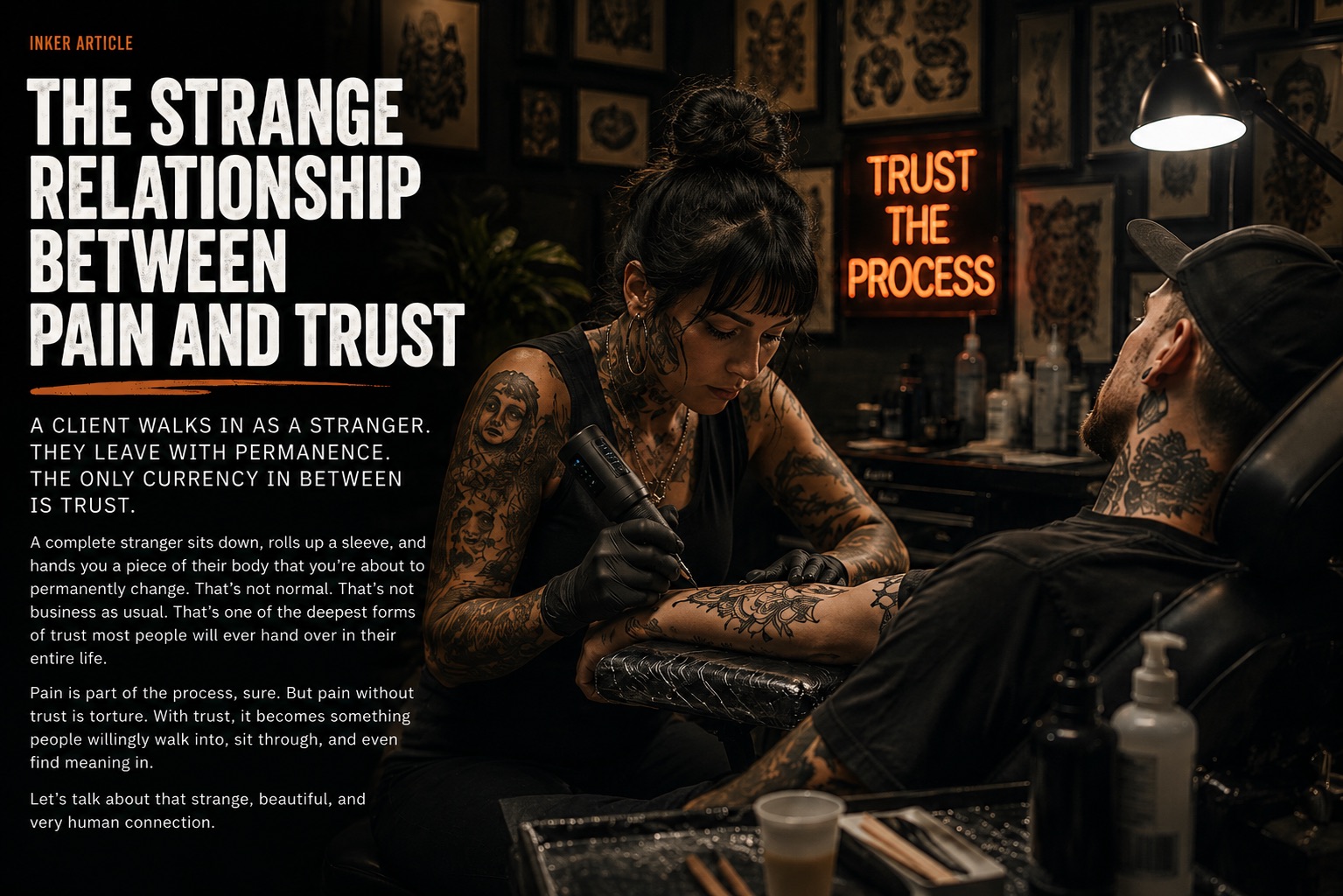
But underneath all the social media clips, lights, dramatic reels, luxury studio aesthetics, and heavily filtered “tattoo lifestyle” content floating around online, tattooing is still built on one thing more than anything else, and that's trust. Pain simply happens to be part of the transaction.
What people outside tattoo culture almost never fully understand because most clients are not walking into shops because they enjoy pain. Contrary to online mythology, most people are not sitting there thinking, “I hope this feels like a medieval prison interrogation for the next six hours.” Most clients are nervous like Hell internally even if they pretend otherwise externally. Some walk in overconfident like they're preparing for battle only to start spiritually evacuating their body fifteen minutes into the session the second the needle touches a sensitive area.
Tattoo artists know this, and that's why the atmosphere inside a shop matters far more than people realize because tattooing is psychological long before it becomes physical. The lighting, music, conversation, personality of the artist, and the energy in the room matters. Some artists can calm a nervous client within thirty seconds of sitting down while others somehow manage to increase anxiety before the machine even turns on. You can literally feel the emotional temperature of a room shift depending on who's working inside it.
Because trust changes pain psychologically then the needle(s) hurts less the moment trust enters the room. That's not some romanticized poetic statement either. You can physically watch it happen in real time. I've personally witnessed it countless times. A nervous client walks into a shop stiff, guarded, overthinking every detail, gripping the chair too tightly, mentally preparing for disaster while pretending they're “totally good.” Then the artist starts talking normally, and the conversation loosens up. Environment starts feeling safe and maybe the client laughs, followed by breathing changes, then their body stops fighting itself.
Nothing about the needle changed, Trust did. That's the strange psychological magic sitting underneath tattoo culture that social media almost never captures properly because trust does not compress cleanly into thirty second reels and staged studio clips. Instagram can show portfolios. TikTok can show dramatic edits and cinematic transitions. But neither one fully captures what it feels like to sit in somebody's chair for six hours while they permanently alter your body and somehow convince your nervous system not to panic halfway through the process.
Experience is deeply human, and the reality is, a lot of tattoo sessions are not really about tattoos at all. They are emotional events disguised as appointments. Memorial tattoos, divorce tattoos, sobriety tattoos, reinvention tattoos. “I survived something” tattoos. “I need to feel like myself again” tattoos. Human beings attach enormous emotional weight to permanence whether they consciously admit it or not, which is why people often start telling life stories halfway through sessions they probably wouldn't even tell relatives during Thanksgiving dinner.
Pain lowers emotional walls, and tattoo artists see this constantly. Somebody comes into the shop acting tough, emotionally guarded, fully armored up mentally, and two hours later they're talking about childhood trauma, failed relationships, addiction, grief, or the reason they almost didn't make it through a certain period of their life. The machine starts buzzing and suddenly the human operating system opens up like somebody accidentally hit a hidden diagnostic menu.
Tattooing creates vulnerability. That's why some artists become unforgettable while others simply perform transactions. The best artists are not always just technically dangerous. They understand people. They understand energy, tension, body language, fear, insecurity, ego, and emotional temperature. They know when somebody needs reassurance, silence, humor, distraction, confidence, honesty, or simply somebody who acts calm while they internally question every life decision that led them into that chair.
Some artists can walk into a room and lower tension without even trying because clients instinctively feel safe around them. That kind of presence cannot be faked for very long.
And ironically, online presentation almost completely misunderstands that side of tattoo culture because modern social media keeps rewarding performance over connection. One artist is staging cinematic lifestyle content trying to look mysterious and emotionally unavailable while another artist is quietly building trust, loyalty, repeat clients, and real relationships underneath the surface. One artist is trying to become internet famous while another artist is becoming locally legendary because clients leave feeling understood instead of simply processed.
Distinction matters more than people realize because clients remember how artists made them feel long after they forget the exact details of the appointment itself. They remember whether the artist respected them, if the room felt safe, if the conversation felt genuine, and whether they felt judged. The tattoo becomes psychologically attached to all of it.
Finding the right artist matters far beyond simply liking somebody's portfolio online because tattoos are not Amazon purchases and tattoo artists are not vending machines.
Inker.com separates itself from the circus because tattooing was never supposed to become some cold dopamine harvesting machine where artists spend half their lives feeding algorithms like pigeons fighting over breadcrumbs in a parking lot. Somewhere along the line, too much of the industry started rewarding performance over presence, attention over trust, and optics over actual human connection, which slowly pushed a lot of artists into behaving more like content creators chasing engagement instead of people building long term reputations through experience, consistency, atmosphere, and genuine relationships.
People are not just searching for tattoos anymore because tattoos are permanent, emotional, psychological decisions tied directly to memory. What clients are really searching for are artists they feel comfortable handing permanence over to, environments that feel authentic instead of manufactured, and personalities that psychologically align with the experience they want attached to their body forever. Nobody wants to feel like they're selecting a human being from a digital vending machine full of filtered highlight reels, staged exclusivity, and manufactured scarcity tactics designed to simulate importance.
Inker.com is carving out a different lane inside tattoo culture because it allows artists to be seen as complete human beings instead of reducing them into engagement statistics and artificial online personas. The tattoo itself is only part of the equation. Clients are also absorbing the artist's energy, professionalism, personality, creative identity, and the overall experience surrounding the work. Inker.com creates room for that entire human side of tattooing to exist again instead of forcing everybody into another endless social media performance loop built entirely around optics and validation.
Because at the end of the day, most clients walk into a tattoo shop expecting pain, but underneath all of it they're really searching for somebody they trust. It was always about trust.