
Who Owns Mickey Mouse After He’s Tattooed on Your Arm?
Copyright, Skin, and the Future of Tattoo Artwork
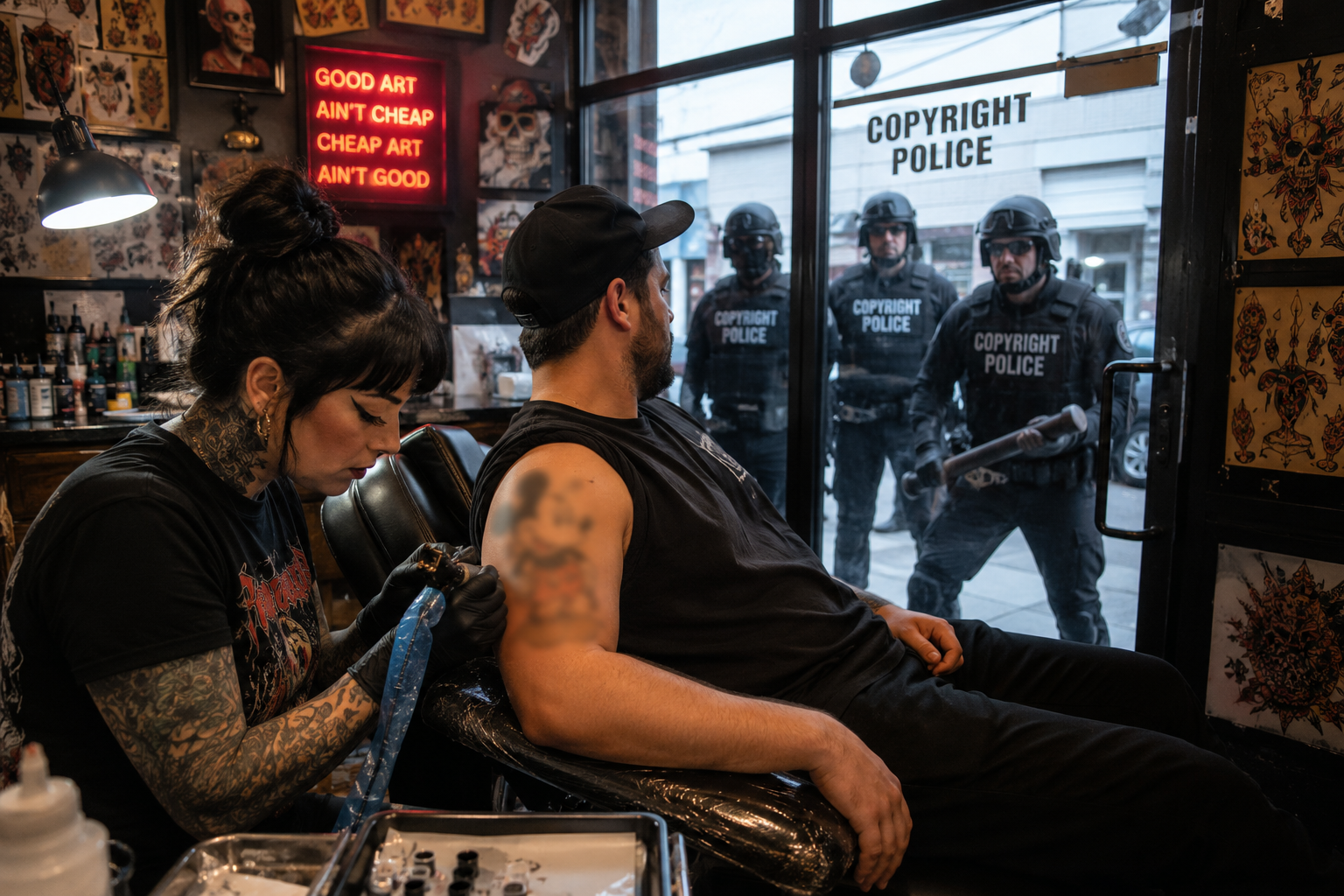
Walk into almost any tattoo shop in America and you are bound to see something that technically belongs to somebody else. Mickey Mouse, Spider Man, Batman, Harley Quinn, the logo of a favorite sports team, or a character from a video game. Every day, tattoo artists across the country permanently place copyrighted imagery onto human skin, and almost nobody stops to think about the legal implications.
That may be the farthest thought in your mind when getting your Tinkerbell tatted, but it raises a question that has quietly existed inside the tattoo industry for decades. When copyrighted artwork becomes a tattoo, who actually owns it? The answer is far more complicated than most people realize because two separate copyright issues can exist at the same time. The first is whether a tattoo itself can be protected as original artwork created by the tattoo artist. The second is whether the artist reproduced somebody else's copyrighted work in the process. In other words, an artist may own rights to the tattoo they created while simultaneously using imagery that belongs to someone else. That contradiction sits at the center of one of the most overlooked legal debates in modern tattooing.
American courts have generally recognized that original tattoo artwork can qualify for copyright protection. If a tattoo artist creates an original design, that artwork may belong to the artist even after it is permanently placed on another person's body.
The client owns the skin, but the artist may still own the artwork. That's where things begin to get interesting. Imagine a tattoo artist spends twenty hours creating a completely original dragon sleeve. The artwork is unique, exists nowhere else in the world, then years later another artist copies that sleeve line for line and tattoos it onto somebody else.
Most artists would immediately recognize that as theft. The original artist created the artwork, and the second artist copied it. Simple, right?!
Now let's reverse the scenario…. A customer walks into a tattoo shop and asks for Mickey Mouse, or a Spider Man, Bat Man, maybe Pikachu tattoo, and suddenly the tattoo artist is no longer the copyright owner. They may be reproducing artwork that already belongs to someone else. From a legal standpoint, that creates a completely different issue.
The artist is charging money to recreate intellectual property owned by another party. Then, the customer is receiving the tattoo. During this exchange, the copyright owner is not being compensated. On paper that creates potential copyright infringement concerns. Yet Disney is not filing lawsuits against every tattoo artist in America. Why?
There are thousands of tattoo artists creating copyrighted imagery every day. Enforcement and litigation are expensive. The damages may be small compared to the cost of pursuing the claim, so companies pick their battles carefully. That doesn't necessarily make the activity legal, it simply means enforcement is selective.
One of the most important tattoo copyright cases in recent history involved celebrity tattoo artist Kat Von D. In 2021, photographer Jeffrey Sedlik sued Kat Von D after she created a tattoo based on his famous photograph of jazz legend Miles Davis. The lawsuit became one of the most closely watched intellectual property battles the tattoo industry had ever seen because it raised a question many artists had quietly wondered about for years. Can a tattoo artist be sued for using a copyrighted photograph as a reference image? After a trial in federal court, a Los Angeles jury ruled in favor of Kat Von D. The jury found that the tattoo was not substantially similar enough to the original photograph to constitute copyright infringement. The jury also found that certain social media posts connected to the tattoo qualified as fair use. The decision was later upheld on appeal, although the legal issues surrounding the case continue to generate debate among copyright attorneys and artists alike.
The significance of the Kat Von D case extends far beyond a dispute between a celebrity tattoo artist and a photographer. For one of the first times in modern tattooing, a highly publicized lawsuit forced the industry to confront questions that had largely been ignored for decades despite affecting artists every single day. Where does inspiration end and copying begin? What rights belong to the original creator of an image? What rights belong to the tattoo artist who transforms that image into a tattoo? What rights, if any, belong to the person who will carry that artwork on their body for the rest of their life?
The truth is that the law has not provided clear answers to many of these questions, which leaves artists operating in an environment where customs and industry practices often fill the gaps that legal precedent has yet to fully address. As tattooing continues its evolution from a niche subculture into a mainstream art form, these issues are becoming increasingly difficult to ignore.
The irony is impossible to miss and many tattoo artists become understandably frustrated when someone copies their original designs, reposts their artwork online without permission, or recreates one of their custom pieces for another client, yet some of those same artists routinely tattoo copyrighted characters, logos, and imagery that belong to someone else, lol.
At the same time, technology is accelerating the problem at a pace the industry has never experienced before. Portfolios are now shared globally within seconds, artwork can be copied and distributed across countless platforms with a few clicks, and artificial intelligence has introduced an entirely new layer of uncertainty by generating images that may be influenced by millions of existing works. In that environment, the ability to establish authorship and prove who created a design first is becoming increasingly valuable.
That reality is one of the driving forces behind the Digital Artwork Marketplace currently being developed by Inker.com. The goal is not simply to create another venue where artists can buy and sell artwork, but to provide a platform where creators can document ownership, establish provenance, license designs under clearly defined terms, and maintain a transparent record of how their artwork moves through the marketplace. As questions surrounding ownership, originality, and copyright continue to grow, tools that help artists protect and monetize their creative work may become just as important as the artwork itself.
Artists will be able to upload original artwork and choose whether they want to sell the artwork outright, license the artwork for tattoo use, or retain ownership while granting limited usage rights. Collectors, studios, and fellow artists will have a transparent method of acquiring artwork directly from the creator rather than relying on screenshots, reposts, and questionable online sources.
More importantly, the platform is being designed with artist protection in mind. The goal is to help establish a clearer chain of ownership and attribution in an industry where original creators are often forgotten once an image begins circulating online.
Will technology solve every copyright problem facing tattoo artists? Of course not. But the future of tattooing may depend less on who can copy artwork and more on who can prove they created it.
As tattooing continues to evolve from an underground trade into a global art industry, the conversation surrounding ownership, originality, licensing, and artist rights is only beginning.